Third Places in Los Angeles
Not home, not work. The lawns, markets, beer gardens and run clubs where strangers in LA still end up talking to each other.
There’s a moment, about ten days after a move, that nobody warns you about. The boxes are gone. The Wi-Fi works. You’ve found a grocery store and a route to work and the good taco place, and you sit down on a Saturday afternoon with the whole day open and realise your phone hasn’t buzzed since Tuesday.
It isn’t sadness exactly. It’s quieter than that. It’s the discovery that everything you used to do on a Saturday had a person attached to it, and the people stayed behind.
Los Angeles is a particularly good city to feel this in. It is enormous, it is beautiful, it is full of people who are also new, and it is built so that none of you will ever bump into each other. So here is a plan. Not a list of bars. A plan, in order, built around the way friendship actually forms: proximity, repetition and unstructured time, applied to a city that resists all three.
Before you do anything social, get a map and draw a circle around your apartment. Twenty minutes’ drive, in evening traffic, without the freeway if you can help it. That’s your city now.
This feels like giving something up. It’s the opposite. Angelenos who’ve been here a decade will tell you that their real friends, the ones they see on a weeknight, all live inside about four miles. The rest are people they love and see at birthdays. A friendship that requires the 405 does not survive contact with a normal week, and the first three months are nothing but normal weeks.
So pick the circle and mean it. If you live in Culver City, your life is the Westside for now. Silver Lake, Los Feliz, Echo Park are one world; Santa Monica and Venice another; Pasadena and Highland Park a third. You can cross later, once you have someone worth crossing for.

Now, inside the circle, find three things that happen every week at a fixed time. Not three great things. Three recurring things.
A run club, even if you walk the back of it. A pickup game, a climbing gym, a trivia night, a Sunday market, a weekly class, a volunteer shift, a reading at a bookshop. The content barely matters. What matters is the cadence, because a thing that’s on again next Wednesday removes the two hardest parts of adult friendship: deciding to go, and having an excuse to see the same faces twice.
LA is spectacular at this once you know to look. Venice Run Club on a Wednesday night draws crowds in the hundreds. Smorgasburg is every Sunday. Griffith Observatory runs a free public star party every month where strangers queue to look at Saturn together. Nearly every neighbourhood has a run club, a farmers’ market and a bar with a quiz. Pick three inside your circle. Put them in the calendar as standing appointments, the way you’d put in a dentist.
This is the part everyone skips, so it gets its own month.
The first time you go to anything, you will meet nobody. You’ll arrive, feel conspicuous, talk to one person for four minutes about parking, and leave thinking it didn’t work. It did work. You were seen. Friendship is counted in hours, not introductions, and the first visit is worth about one of the fifty it takes to make a casual friend. It cannot be good enough to matter and it cannot be bad enough to matter either.
The second visit is where it starts. Someone half-recognises you. You half-recognise them. The third week, you nod. The fourth, you’re the two people who were both here last time, which is a relationship. Repetition does what charm can’t: it turns you from a stranger into a regular, and regulars get talked to.
Two rules for this stretch. Go alone, because arriving with someone is socially airtight and you’ll leave having met no one. And stay twenty minutes past the point you wanted to leave, because that’s exactly when the people who are staying start talking to each other.
By now you have faces. The run club woman with the dog. The two guys who always lose at trivia. The person at the market who also buys the ugly tomatoes. You’ve said hello a dozen times and it hasn’t gone anywhere, because everyone is waiting for someone else to propose something.
Be the one who proposes. Not a big thing: the sideways move. “A few of us are getting a drink after, come.” “I’m going to that thing Saturday, want to come?” The lowest-stakes invitation you can make, to the most obvious person, about something that’s happening anyway.
In Los Angeles, this is rarer than it should be, and it’s rare for a structural reason, not a personal one. Everyone here has done the maths on traffic and quietly stopped inviting. Which means the person who does invite isn’t competing with anybody. You will be surprised how often the answer is yes, and how grateful the yes sounds.

Some of those yeses won’t show. This is Los Angeles. Plan for it instead of taking it personally.
Prefer plans that still work at two people. Invite one more than you need. And when someone cancels, which they will, do the thing that almost nobody does: propose the next one, immediately, casually, without a trace of injury. “No worries, next week?” Most friendships in this city die not from rejection but from two people each waiting for the other to reschedule. Be the one who reschedules. It costs nothing and it is, quietly, the whole skill.
By now you should also notice something about your calendar. Week eight is about the point where the recurring things stop being effort and start being Tuesday. That is not a sign you’ve plateaued. That’s the hours accumulating, which is the only thing that was ever going to work.
The last stretch is about converting. Somewhere in the people you’ve been seeing is one, maybe two, you actually like. The goal of the final month is to get one of them onto a standing thing of your own: a Thursday, a Sunday walk, a weekly game. Anything that happens without being arranged each time.
Once you have that, you’re no longer new. You have a person you see without planning, which is the actual definition of a friend, and the city stops being somewhere you live and becomes somewhere you’re from.
Ninety days gets you to the start. The research is clear that a close friend takes something like two hundred hours of unstructured time, and three months of weekly things is maybe forty. What you’ll have at the end of this isn’t a best friend. It’s a social life with momentum: faces, regulars, a standing thing, and the one habit that matters, which is proposing. The rest is arithmetic, and the arithmetic is on your side now.
Everything above is a version of the same job: find a place, pick a time, get a few people to show up, and do it again next week. That job is why most people’s first year in LA is lonelier than it needed to be. It’s also the job we built Buffet to do.
Every week there’s a short list of things happening around Los Angeles. You claim a plate at one. When the third person claims a seat the group is real and the chat opens. Six or less, all of whom chose the same night you did, none of whom you have to organise.
It’s the sideways move, made for you, every week, starting week one.
Download Buffet, draw your circle, and go.

Not home, not work. The lawns, markets, beer gardens and run clubs where strangers in LA still end up talking to each other.

A researcher put a number on it — roughly 50 hours to a casual friend, more than 200 to a close one. The number isn't the discouraging part.
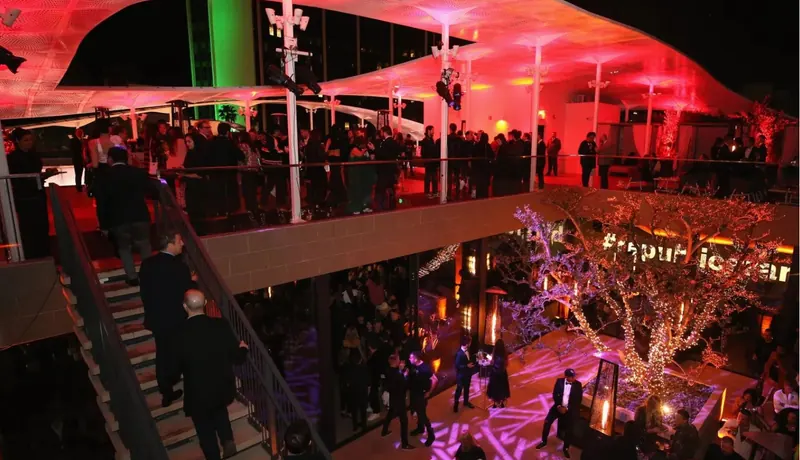
LA isn't unfriendly. It's just 500 square miles with a car between every two people. Here's what actually works.